por
por In today’s fast-paced and highly competitive business environment, companies are constantly searching for ways to improve efficiency, increase sales, and build stronger customer relationships. One of the most powerful tools driving this transformation is the Customer Relationship Management (CRM) system.
Over the past decade—and especially leading into 2026—CRM adoption has grown rapidly across industries. From startups to large enterprises, businesses are relying more than ever on CRM platforms to manage customer interactions, streamline operations, and make smarter decisions.
But why exactly are companies turning to CRM systems at such a fast rate? The answer lies in a combination of technological evolution, changing customer expectations, and the growing need for data-driven strategies.
The Shift Toward Customer-Centric Business Models
Modern businesses are no longer product-focused—they are customer-focused. Companies now understand that long-term success depends on building meaningful customer relationships rather than just making one-time sales.
CRM systems enable this transformation by allowing organizations to:
- Track every customer interaction
- Understand individual customer preferences
- Deliver personalized experiences
Instead of treating customers as transactions, businesses can now treat them as long-term assets.
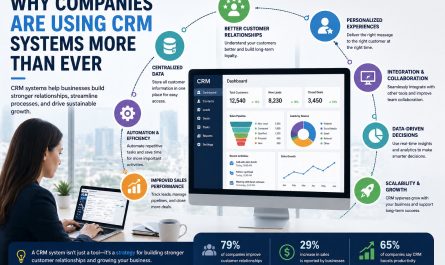
Centralized Data: The Foundation of Better Decisions
One of the main reasons companies adopt CRM systems is the ability to centralize customer data.
Without a CRM platform, information is often scattered across:
- Emails
- Spreadsheets
- Messaging platforms
- Sales notes
This fragmentation leads to inefficiencies and errors.
A CRM system consolidates all customer data into one platform, making it easy to:
- Access real-time information
- Analyze customer behavior
- Make informed business decisions
In a world driven by data, having a centralized system is a major competitive advantage.
Automation: Saving Time and Increasing Productivity
Another major driver of CRM adoption is automation.
Modern CRM systems can automate repetitive tasks such as:
- Sending follow-up emails
- Assigning leads to sales representatives
- Scheduling reminders
- Managing workflows
This reduces manual work and allows employees to focus on high-value activities, such as closing deals and building relationships.
Automation not only saves time but also improves consistency and reduces human error.
Improved Sales Performance
CRM systems play a crucial role in boosting sales performance.
They provide sales teams with tools to:
- Track leads and opportunities
- Manage sales pipelines effectively
- Prioritize high-value prospects
- Forecast future revenue
With better visibility into the sales process, companies can identify bottlenecks and optimize their strategies.
As a result, businesses that use CRM software often experience higher conversion rates and increased revenue.
Enhanced Customer Experience
Customer experience has become one of the most important differentiators in modern business.
Consumers expect:
- Fast responses
- Personalized communication
- Seamless interactions across channels
CRM systems help companies meet these expectations by providing a complete view of the customer journey.
For example, a customer service representative can instantly access:
- Purchase history
- Previous interactions
- Customer preferences and needs
This enables more efficient and personalized support, leading to higher customer satisfaction.
Integration with Modern Business Tools
Today’s CRM platforms are no longer standalone systems—they are part of a larger digital ecosystem.
They can integrate with:
- Email marketing tools
- Social media platforms
- E-commerce systems
- Accounting software
This integration allows data flow across departments, improving collaboration and efficiency.
As businesses rely more on digital tools, having an integrated CRM system becomes essential.
Data-Driven Marketing Strategies
Marketing has evolved from guesswork to precision targeting.
CRM systems enable companies to:
- Segment their audience
- Analyze campaign performance
- Personalize marketing messages
- Track customer engagement
With access to detailed customer data, businesses can create more effective campaigns and achieve better return on investment (ROI).
This is one of the main reasons marketing teams increasingly depend on CRM platforms.
Scalability and Business Growth
As companies grow, managing customer relationships becomes more complex.
What works for a small business—such as spreadsheets or manual tracking—quickly becomes inefficient at scale.
CRM systems provide:
- Structured processes
- Automated workflows
- Scalable infrastructure
This allows businesses to grow without losing control over operations.
Whether a company has 100 customers or 100,000 customers, a CRM ensures consistent management.
Artificial Intelligence and Predictive Insights
One of the most significant advancements in CRM technology is the integration of Artificial Intelligence (AI).
Modern CRM systems can:
- Predict customer behavior
- Identify sales opportunities
- Recommend next actions
- Analyze trends in real time
These capabilities give companies a strategic advantage by enabling proactive decision-making.
Instead of reacting to problems, businesses can anticipate them and act in advance.
Remote Work and Digital Transformation
The rise of remote work has accelerated the adoption of CRM systems.
With distributed teams, companies need tools that allow:
- Access from anywhere
- Real-time collaboration
- Cloud-based data management
CRM platforms provide these capabilities, making them essential for modern work environments.
They also support digital transformation initiatives, helping businesses move away from outdated systems.
Competitive Pressure and Market Trends
As more companies adopt CRM systems, those that don’t risk falling behind.
Competitors using CRM tools can:
- Respond faster to customers
- Personalize interactions
- Optimize their sales processes
This creates pressure for other businesses to adopt similar technologies.
In many industries, using a CRM platform is no longer a competitive advantage—it is a baseline requirement.
Common Challenges and How Companies Overcome Them
Despite their many benefits, CRM systems can present challenges.
1. Implementation Complexity
Some CRM systems can be difficult to implement.
Solution: Choose user-friendly CRM platforms and start with basic features.
2. User Adoption
Employees may resist using a new system.
Solution: Provide proper training and demonstrate the value of the CRM.
3. Data Quality Issues
Poor data quality can affect CRM performance.
Solution: Clean and standardize data before implementation.
By addressing these challenges, companies can maximize the benefits of their CRM systems.
The Future of CRM Systems
Looking ahead, CRM technology will continue evolving with new innovations such as:
- Advanced AI and machine learning
- Voice integration and chatbots
- Hyper-personalization
- Real-time analytics
These innovations will further improve how businesses connect with customers and drive growth.
Conclusion
The increasing adoption of CRM systems is not just a trend—it reflects how modern businesses operate.
Companies are using CRM platforms because they:
- Centralize data
- Automate processes
- Improve sales performance
- Enhance customer experience
- Enable data-driven decision-making
In a world where customer expectations are higher than ever, businesses need tools that help them stay competitive and efficient.
CRM systems provide exactly that.
As we move further into 2026 and beyond, companies that embrace CRM technology will be better positioned to grow, scale, and build lasting customer relationships.