por
por In today’s increasingly competitive market, understanding customers is no longer optional—it is a necessity. Many companies lose sales not because their product is bad, but because they fail to properly manage customer relationships. This is where CRM comes in.
When we talk about CRM (Customer Relationship Management), we are referring to a strategic tool that helps organize, automate, and improve every interaction with current and potential customers. From sales to customer service, a good CRM software can make the difference between a disorganized company and a highly profitable one.
In this article, I will explain what a CRM is, what it is used for, its main benefits, and why implementing one can completely transform business management.
What Is a CRM?
A CRM, or Customer Relationship Management system, is software designed to centralize all information related to a company’s customers.
Its main function is to help organizations manage contacts, sales, follow-ups, marketing campaigns, and customer service from a single platform.
Simply put: a CRM allows businesses to better understand each customer in order to provide more personalized and efficient service.
Inside a CRM, information such as the following is stored:
- Contact details
- Purchase history
- Previous conversations
- Sales follow-up
- Customer preferences
- Support requests
- Sales opportunities
- Buying behavior
All this information helps companies make smarter decisions and improve customer experience.
What Does CRM Mean?
CRM stands for Customer Relationship Management.
It is not just a sales tool, but a complete business strategy focused on building strong, lasting, and profitable relationships with customers.
Many people think a CRM is only used to increase sales, but in reality, it also helps improve customer loyalty, service quality, and internal efficiency.
What Is a CRM Used For?
CRM software helps improve the relationship between a company and its customers throughout the entire sales cycle.
This includes everything from the first contact to post-sale support.
Its main functions include:
Customer Database Organization
It keeps all customer information in one place, avoiding scattered Excel files, lost notes, or duplicated data.
Sales Tracking
It helps monitor every business opportunity, from the first contact to closing the deal.
Task Automation
It reduces manual work through automatic reminders, email sequences, lead follow-ups, and scheduled activities.
Better Customer Service
It allows faster and more personalized responses thanks to the complete customer history.
Reports and Analytics
It generates reports to measure performance, identify opportunities, and improve decision-making.
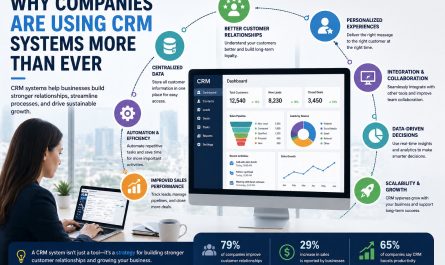
Importance of CRM in Business Management
The importance of CRM lies in its ability to turn data into strategic decisions.
Today, competition depends not only on price or product quality, but also on the customer experience.
Implementing a CRM allows companies to work more efficiently, reduce errors, and increase profitability.
These are the main reasons why CRM is essential:
Main Benefits of Implementing a CRM
1. Complete Customer View
One of the greatest benefits of CRM is that it provides a 360-degree view of each customer.
This means sales, marketing, and customer service teams can access the same updated history.
This leads to:
- Greater personalization
- Better communication
- Faster responses
- Higher customer satisfaction
When you know your customer well, you sell better.
2. Improved Internal Communication
Many companies suffer from a silent problem: poor communication between departments.
The sales team does not know what support did. Marketing does not know the commercial history. Customer service works blindly.
A CRM solves this problem because all information is centralized.
This improves:
- Team coordination
- Productivity
- Customer experience
- Response speed
3. Process Automation
Repetitive tasks consume time and reduce productivity.
A CRM allows automation of actions such as:
- Prospect follow-up
- Automated emails
- Call reminders
- Task assignments
- Sales alerts
This frees up time to focus on more important strategies.
And honestly, working smarter always beats working longer.
4. Sales Process Optimization
A CRM helps manage the entire sales funnel.
From lead generation to closing the sale, every stage is recorded.
This allows businesses to:
- Identify real opportunities
- Avoid losing prospects
- Measure team performance
- Improve conversion rates
When sales are measured, sales improve.
5. Data-Driven Decision Making
Many companies still make decisions based on intuition.
That is a mistake.
A CRM provides real reports on:
- Sales performance
- Most profitable customers
- Most effective campaigns
- Average closing time
- Conversion rates
With clear data, decisions stop being guesses.
6. Better Customer Service
Today, customers do not just buy products—they buy experiences.
If a customer feels they have to explain the same problem five times, they probably will not come back.
With a CRM, the support team can quickly access the customer’s full history and provide faster, more personalized solutions.
This creates:
- Greater satisfaction
- Better reputation
- More referrals
- Higher customer retention
And keeping customers is always cheaper than finding new ones.
Most Common Types of CRM
Not all CRMs work the same way. There are different types depending on business needs.
Operational CRM
Focused on sales, marketing, and process automation.
Ideal for companies looking for commercial efficiency.
Analytical CRM
Focused on data analysis and customer behavior.
Perfect for businesses that make strategic decisions based on insights.
Collaborative CRM
Improves communication between departments and enhances customer experience.
Very useful for organizations with multiple teams.
Comparison Table: Company With CRM vs Company Without CRM
| Aspect | Company Without CRM | Company With CRM |
|---|---|---|
| Customer Information | Disorganized and scattered | Centralized and accessible |
| Sales Follow-Up | Manual and inaccurate | Automated and efficient |
| Customer Service | Slow and generic | Fast and personalized |
| Decision Making | Based on intuition | Based on data |
| Productivity | Low | High |
| Customer Retention | Difficult | Much more effective |
The difference is not small. It is massive.
Which Companies Need a CRM?
The short answer is: almost all of them.
It does not matter if you have a small business, an SME, or a large corporation.
If you have customers, you need a strategy to manage them.
CRM is especially useful for:
- Service companies
- B2B businesses
- Sales teams
- E-commerce stores
- Real estate agencies
- Clinics
- Marketing agencies
- Consulting firms
- Educational centers
- Technical support companies
Even a small business can grow much faster with the right CRM.
How to Choose the Best CRM Software
Choosing a CRM should not be based on trends, but on business needs.
I always recommend evaluating these points:
Ease of Use
If your team does not use it, it is useless.
Scalability
It should grow together with your business.
Integrations
It must connect with email, WhatsApp, ERP, marketing tools, and other platforms.
Technical Support
Good support makes a huge difference.
Price vs Value
Do not look for the cheapest one. Look for the one that actually solves problems.
A cheap CRM that nobody uses ends up being expensive.
Conclusion
Implementing a CRM is no longer a trend—it is a business necessity.
Customer management defines a large part of a company’s growth, and CRM software helps turn disorganized processes into profitable strategies.
Centralizing information, automating tasks, improving sales, and delivering better customer service are just some of its advantages.
From my experience, the companies that truly grow are not the ones that sell the most today, but the ones that manage relationships best over time.
If you are not using a CRM yet, now may be the best time to start.
Because understanding your customers better will always be the smartest investment.