por
por In 2026, the textile industry is more competitive than ever. Companies are no longer competing only on price or product quality, but also on customer experience, speed, and data-driven decisions. This is where a Customer Relationship Management (CRM) system becomes essential.
For textile businesses—whether focused on manufacturing, wholesale, or retail—implementing a CRM system can streamline operations, strengthen client relationships, and significantly increase profitability.
What is a CRM and Why It Matters for Textile Companies?
A CRM is a software platform designed to manage customer interactions, sales processes, and business data in one centralized system.
For a textile company, this includes:
- Managing wholesale buyers and distributors
- Tracking orders and production timelines
- Monitoring customer preferences and purchase history
- Automating communication and follow-ups
Unlike traditional methods such as spreadsheets, emails, or manual logs, a CRM platform provides real-time visibility and automation, allowing companies to operate more efficiently.
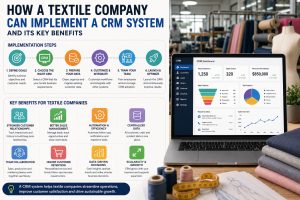
Step-by-Step: How a Textile Company Can Implement a CRM System
Implementing a CRM system is not just about installing software—it requires a structured strategy.
1. Define Business Goals and Needs
Before choosing a CRM, the company must clearly define what it wants to achieve.
Common goals in the textile industry include:
- Improving communication with wholesale clients
- Tracking bulk orders and delivery schedules
- Increasing repeat purchases
- Managing sales teams more efficiently
Understanding these goals ensures the CRM software aligns with business operations.
2. Choose the Right CRM Platform
Not all CRM systems are the same. Textile companies should look for features such as:
- Order tracking and pipeline management
- Integration with inventory systems
- Automation of sales processes
- Reporting and analytics
Popular options include HubSpot CRM, Salesforce, and Zoho CRM, each offering different levels of customization and scalability.
3. Clean and Organize Existing Data
Before migrating to the CRM platform, the company should:
- Remove duplicate contacts
- Update outdated customer information
- Standardize data formats
Clean data ensures accurate reporting and better automation once the system is live.
4. Customize the CRM for Textile Operations
A textile business has unique workflows that must be reflected in the CRM system.
Customization may include:
- Sales pipelines for bulk orders
- Fields for fabric type, color, and quantity
- Production status tracking
- Client segmentation (retailers, distributors, exporters)
This step is critical to make the CRM truly useful.
5. Integrate with Other Systems
To maximize efficiency, the CRM system should connect with:
- Inventory management systems
- Accounting software
- Email marketing tools
- E-commerce platforms
Integration allows seamless data flow across departments.
6. Train Employees
A CRM system is only effective if employees use it properly.
Training should cover:
- How to input and update data
- Managing customer interactions
- Using automation tools
- Generating reports
Employee adoption is often the biggest challenge, so training is essential.
7. Launch and Optimize
After implementation, the company should:
- Monitor performance
- Collect feedback from users
- Adjust workflows and automation
CRM systems improve over time with continuous optimization.
Key Benefits of CRM for Textile Companies
Once properly implemented, a CRM platform can transform a textile business in multiple ways.
1. Improved Customer Relationships
Textile companies often work with long-term clients such as retailers and distributors. A CRM allows businesses to:
- Track communication history
- Understand customer preferences
- Provide personalized service
This leads to stronger customer relationships and higher customer retention.
2. Better Sales Management
With a CRM system, sales teams can:
- Track leads and opportunities
- Monitor deal progress
- Forecast sales accurately
Managers gain full visibility into the sales pipeline, helping them make better decisions.
3. Increased Efficiency Through Automation
Automation is one of the biggest advantages of CRM systems.
Textile companies can automate:
- Follow-up emails
- Order confirmations
- Reminders for repeat orders
- Internal notifications
This reduces manual work and saves time.
4. Centralized Data and Better Decision-Making
Instead of scattered information across multiple tools, a CRM centralizes everything.
This allows companies to:
- Analyze customer behavior
- Identify best-selling products
- Detect market trends
Data-driven decisions lead to better business outcomes.
5. Enhanced Collaboration Across Departments
A CRM system connects sales, marketing, and operations teams.
For example:
- Sales teams can see production status
- Operations can access customer requirements
- Marketing can target specific client segments
This alignment improves overall efficiency.
6. Higher Customer Retention and Repeat Sales
By tracking customer behavior and automating follow-ups, companies can:
- Re-engage inactive clients
- Offer personalized promotions
- Build loyalty programs
Repeat customers are often more profitable than new customers.
7. Scalability for Growth
As a textile company grows, managing customers manually becomes impossible.
A CRM system provides:
- Structured processes
- Automated workflows
- Scalable systems
This allows the business to expand without losing control.
Common Challenges and How to Overcome Them
Although CRM implementation offers many benefits, companies may face challenges.
Resistance to Change
Employees may prefer traditional methods.
Solution: Provide proper training and clearly explain the benefits.
Data Migration Issues
Poor data quality can affect CRM performance.
Solution: Clean and organize data before migration.
High Initial Costs
Some CRM platforms can be expensive.
Solution: Start with scalable or affordable CRM options.
Conclusion
In today’s fast-paced textile industry, implementing a CRM system is no longer optional—it is a strategic necessity.
By following a structured implementation process, textile companies can:
- Improve customer relationships
- Increase sales efficiency
- Automate repetitive tasks
- Make better data-driven decisions
Platforms like HubSpot CRM, Salesforce, and Zoho CRM offer powerful solutions that can be adapted to the specific needs of textile businesses.
Ultimately, a well-implemented CRM platform not only improves daily operations but also creates a strong foundation for long-term growth, scalability, and competitiveness in the global textile market.