por
por In 2026, Customer Relationship Management (CRM) systems have become the core of any modern business. They are no longer just tools for storing contacts—today’s CRMs integrate artificial intelligence, advanced automation, omnichannel marketing, and predictive analytics, helping companies increase sales and build stronger customer relationships.
Choosing the right CRM can mean the difference between scaling your business or missing valuable opportunities. In this guide, we break down the best CRM platforms of 2026, their strengths, weaknesses, and which one fits your business best.
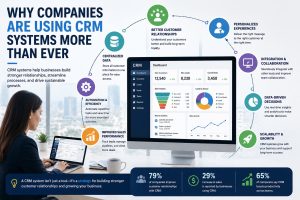
What is a CRM and Why It Matters in 2026?
A CRM is a platform designed to manage:
- Customers and leads
- Sales pipelines and opportunities
- Marketing automation
- Customer support
- Data analytics
In 2026, CRM platforms have evolved into intelligent, interconnected ecosystems.
Key Trends in CRM for 2026
- Built-in AI for sales prediction and automation
- Fully automated sales workflows
- Integration with email, social media, and eCommerce tools
- True omnichannel customer experiences
Best CRM Platforms in 2026
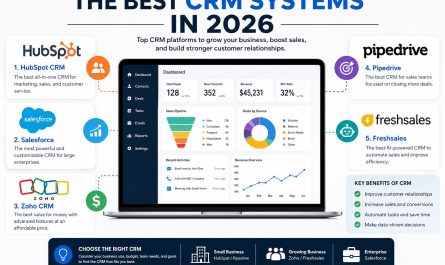
1. HubSpot CRM: The Best All-Around CRM in 2026
HubSpot CRM continues to dominate as one of the most balanced CRM platforms available. Its biggest strength is combining marketing, sales, and customer service into a single ecosystem.
Pros
- Powerful free plan
- Extremely user-friendly interface
- Built-in automation
- All-in-one platform (marketing + sales + support)
- Extensive integrations
Cons
- Can become expensive as you scale
- Advanced features require premium plans
Best for
- Startups
- Small businesses
- Digital entrepreneurs
HubSpot is widely considered the best overall CRM due to its ease of use and complete feature set.
2. Salesforce: The Most Powerful CRM for Large Businesses
Salesforce remains the global leader in CRM technology. It is the most customizable and scalable CRM platform on the market.
Pros
- Highly customizable
- Virtually unlimited scalability
- Advanced AI (Einstein AI)
- Massive app ecosystem
Cons
- Steep learning curve
- Expensive, especially with add-ons
- Requires technical setup
Best for
- Large enterprises
- Complex sales teams
- B2B organizations
It is the most powerful CRM software available—but not always the most practical for smaller teams.
3. Zoho CRM: Best Value for Money
Zoho CRM has grown significantly thanks to its ability to deliver advanced features at an affordable price.
Pros
- Excellent price-to-feature ratio
- Built-in AI (Zia)
- Wide ecosystem of Zoho apps
- Strong automation features
Cons
- Less intuitive interface
- Setup can be complex
Best for
- Growing businesses
- Budget-conscious companies
- Flexible teams
Zoho CRM stands out for offering enterprise-level capabilities at a fraction of the cost.
4. Pipedrive: Best CRM for Sales Teams
Pipedrive is built specifically for sales performance. Its simplicity and visual sales pipeline make it highly effective.
Pros
- Visual sales pipeline
- Very easy to use
- Sales-focused design
- Excellent for tracking deals
Cons
- Limited marketing features
- Not as comprehensive as other CRMs
Best for
- Sales teams
- Freelancers
- Small businesses
It’s one of the best tools for improving conversions and managing deals efficiently.
5. Freshsales: The Best AI-Powered CRM
Freshsales (by Freshworks) is one of the fastest-growing CRM platforms, known for strong AI capabilities.
Pros
- Advanced AI (Freddy AI)
- Sales automation
- Real-time analytics
- Modern interface
Cons
- Fewer integrations than Salesforce
- Limited support on lower plans
Best for
- Tech startups
- Automation-focused teams
- Efficiency-driven businesses
It includes features like automated email generation and customer behavior tracking.
How to Choose the Best CRM in 2026
There is no one-size-fits-all CRM. Your choice depends on several key factors:
1. Business Size
- Small → HubSpot or Pipedrive
- Medium → Zoho or Freshsales
- Large → Salesforce
2. Budget
- Low → Zoho CRM
- Medium → HubSpot CRM
- High → Salesforce
3. Business Complexity
- Simple processes → Pipedrive
- Marketing + sales → HubSpot
- Complex operations → Salesforce
4. Technical Skill Level
- Low → HubSpot
- Medium → Freshsales
- High → Salesforce / Zoho
Key CRM Trends in 2026
1. AI as the Standard
Artificial intelligence is now essential. It helps:
- Predict sales outcomes
- Automate communications
- Analyze customer behavior
2. All-in-One Platforms
Businesses prefer CRM platforms that combine:
- Marketing
- Sales
- Customer support
This reduces costs and improves efficiency.
3. Full Automation
Modern CRM systems allow:
- Automated follow-ups
- Smart workflows
- Dynamic segmentation
4. User Experience Matters
Even the most powerful CRM can fail if it’s too complex. Ease of use is critical for team adoption.
Conclusion
In 2026, CRM systems are no longer optional—they are essential for business growth and competitiveness.
Best CRM by Category
- Best overall CRM: HubSpot CRM
- Most powerful CRM: Salesforce
- Best value CRM: Zoho CRM
- Best CRM for sales teams: Pipedrive
- Best AI-powered CRM: Freshsales
The best CRM software for your business depends on your budget, team size, technical skills, and growth goals. Choosing wisely can dramatically improve your sales performance, customer retention, and business efficiency.