 por
por Why It Will Shape the Future of Business
Introduction
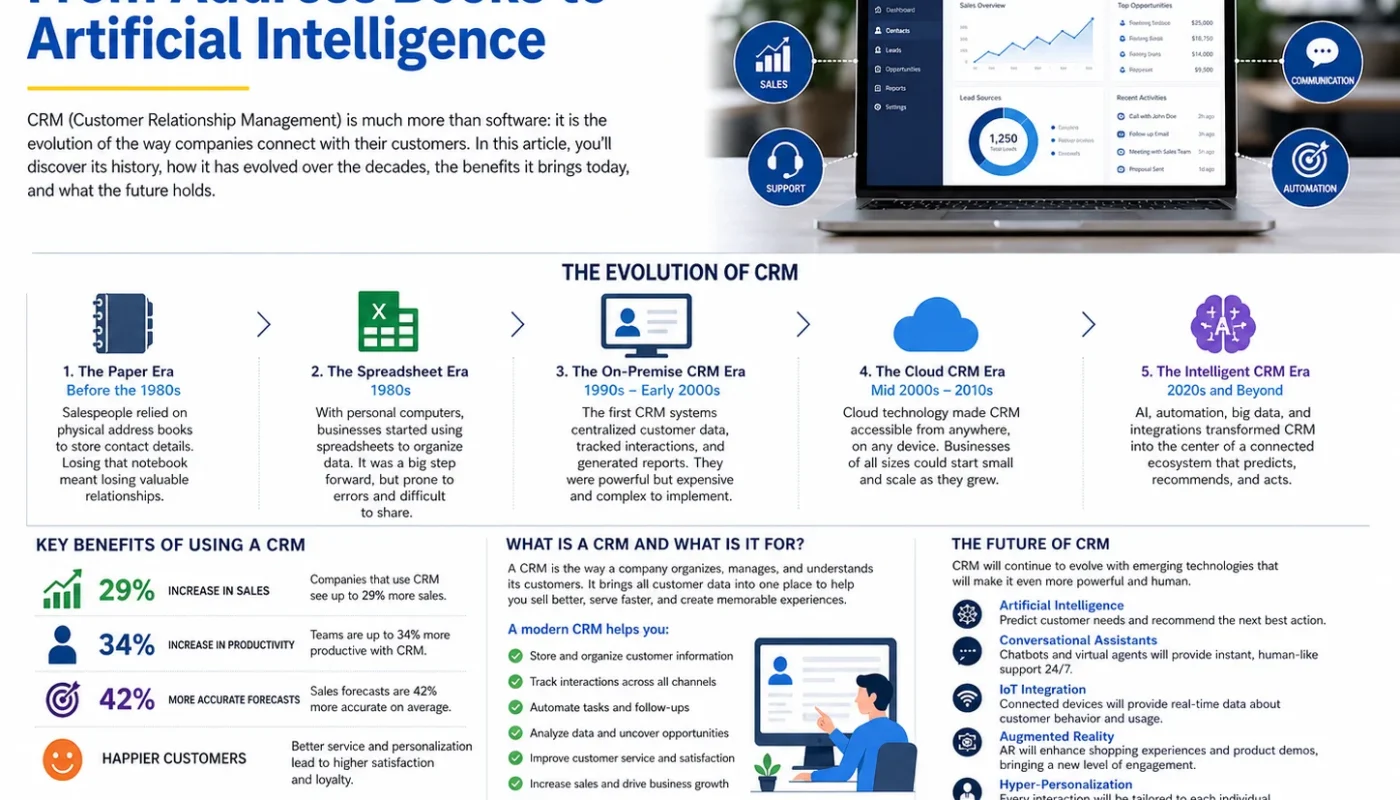
CRM has evolved from a simple contact notebook into one of the most strategic tools in modern business. Today, it does much more than store customer information—it helps companies sell smarter, respond faster, automate workflows, and make decisions based on real data.
In this article, I’ll explain the history of CRM, how it transformed from paper agendas into AI-powered platforms, and why its future will be driven by hyper-personalization, automation, and full digital connectivity. If you want to understand how businesses can better manage customer relationships and prepare for the future, this guide will give you a clear and practical view.
What Is CRM and Why Did It Change Business Management?
CRM stands for Customer Relationship Management, and it refers to a system designed to manage the relationship between a business and its customers. Its main purpose is to centralize information, organize processes, and improve every customer interaction.
But CRM is more than just software—it is also a business strategy. Its true value lies in helping companies understand customers better, anticipate their needs, and build stronger long-term relationships.
In simple terms, a CRM helps businesses:
- Store and organize customer information
- Track sales opportunities
- Automate repetitive tasks
- Improve communication between teams
- Analyze data for better decision-making
Today, this sounds normal. But reaching this level took decades of transformation.
The Early Days: When Everything Depended on a Physical Notebook
A few decades ago, sales management was completely manual. Salespeople carried notebooks where they wrote names, phone numbers, addresses, and important details. The most organized ones even noted birthdays, preferences, and follow-up dates.
That notebook was incredibly valuable—but also extremely fragile. Losing it could mean losing years of relationships, trust, and sales opportunities.
The Limitations of Traditional Methods
Although this system worked for its time, it had obvious problems:
- No backup copies
- Information could not be shared easily
- Real-time updates were impossible
- Follow-ups depended entirely on memory and personal discipline
At that stage, sales were much more personal and manual. Success depended more on the salesperson than on any structured system.
The Arrival of Spreadsheets and the First Major Leap
With the rise of personal computers, tools like Excel changed everything. For many businesses, spreadsheets were a revolution.
For the first time, data could be organized in rows and columns. Companies could classify customers, record sales, and create reports much faster.
What Spreadsheets Improved
Spreadsheets helped businesses:
- Organize large volumes of information
- Reduce calculation errors
- Create basic reports
- Improve sales control
Contenido Relacionado:
What Is a CRM and Why It Is Essential for Business Management
For small businesses, this was a huge step forward. But as companies grew, the limitations became obvious.
The Problems That Came Next
As operations expanded, spreadsheets became harder to manage:
- Duplicate records increased
- Human error remained common
- Information was not collaborative in real time
- Customer interaction history was difficult to track
- Files became slower and less reliable
In short, Excel was useful—but it was never designed for complex customer relationship management.
The Birth of Modern CRM
Between the late 1980s and early 1990s, what we now know as CRM began to take shape. This was both a technological and strategic shift.
For the first time, companies could store customer information in one centralized platform, access it collaboratively, and track sales opportunities more professionally.
What Early CRM Systems Offered
The first CRM systems allowed businesses to:
- Record calls and meetings
- Track business opportunities
- Store customer interaction history
- Generate basic reports
- Improve visibility across the sales process
These systems were expensive, difficult to implement, and often complex to use. Still, they changed everything.
The key lesson became clear: customer data was not just information—it was a strategic asset.
The Big Transformation: Cloud-Based CRM
If there was one major turning point in CRM history, it was the arrival of cloud technology.
Before cloud CRM, businesses needed their own servers, IT teams, and significant budgets just to maintain the system. With cloud solutions, everything changed.
Why Cloud CRM Changed the Game
Cloud-based CRM brought major advantages:
- Access from anywhere
- Lower infrastructure costs
- Automatic updates
- Better scalability
- Mobile access from phones, tablets, and laptops
This made CRM accessible not only to large corporations but also to small and medium-sized businesses.
A New Way of Working
Now, a salesperson can review customer information from a smartphone before a meeting. A manager can check reports in real time. Entire teams can work on the same database without losing information.
That changed the speed of business forever.
CRM as the Center of a Connected Business Ecosystem
Over time, CRM stopped being an isolated tool and became the center of business operations.
Today, a CRM can integrate with:
- Digital marketing tools
- ERP systems
- Email platforms
- Social media channels
- Chatbots
- Customer service platforms
What This Integration Makes Possible
Because of these connections, CRM does not just store information—it interprets and connects it.
This helps businesses understand:
- Which campaigns generate more revenue
- Which channels attract better leads
- How customers behave across platforms
- Where sales opportunities are being lost
- Which actions improve conversion rates
In practice, CRM becomes the brain of the commercial strategy.
Automation: The Step That Changed Productivity
One of the biggest milestones in CRM evolution was automation.
Before, many tasks depended on someone remembering to make a call, send an email, or create a follow-up. Today, the system can handle that automatically.
Tasks a Modern CRM Can Automate
A modern CRM can:
- Send automatic emails
- Schedule follow-up reminders
- Create support tickets
- Assign leads to the right salesperson
- Trigger alerts when opportunities go cold
- Log activities automatically
Real Business Impact
This reduces mistakes, saves time, and allows teams to focus on higher-value activities.
From my experience, this is one of the greatest strengths of CRM: it does not just organize work—it creates more space for better relationships and stronger sales.
Real Benefits of Using CRM the Right Way
When a business implements CRM strategically, results often appear quickly.
1. More Sales
Better lead tracking improves closing rates. Opportunities are no longer lost because of poor follow-up.
2. Higher Productivity
Teams spend less time on manual tasks and more time on activities that generate revenue.
3. Better Customer Service
With complete customer history and updated information, support becomes faster, more accurate, and more human.
4. Smarter Decisions
Reports and analytics help identify what works and what does not, allowing faster strategic adjustments.
5. Stronger Customer Loyalty
A well-served customer is much more likely to return. And in business, retention is always more profitable than constant acquisition.
Quick Comparison: Then vs. Now in Customer Management
| Stage | How Customers Were Managed | Main Limitations |
|---|---|---|
| Physical Notebook | Manual notes and scattered contacts | Information could be lost, no collaboration |
| Spreadsheets | Basic organization in tables | Errors, duplicates, poor scalability |
| Early CRM | Centralized tracking and reports | Expensive and difficult to use |
| Cloud CRM | Real-time access and mobility | Internet dependency, but much greater flexibility |
| Smart CRM | Automation, AI, and predictive analytics | Requires strong adoption strategy |
This evolution proves something important: CRM has grown alongside customer expectations.
The Future of CRM: Smarter, Faster, and More Human
The future of CRM is not just about more technology. It is about better technology built to understand people.
Artificial Intelligence and Predictive Analytics
Future CRM platforms will use AI to:
- Predict which customer is most likely to buy
- Recommend the next best action
- Detect churn risks early
- Suggest personalized communication
- Prioritize high-value opportunities
Hyper-Personalization
Using a customer’s name will no longer be enough. Businesses will create experiences tailored to behavior, timing, and individual preferences.
This means more relevant communication, better offers, and more natural interactions.
Conversational Assistants and Advanced Automation
Chatbots and virtual assistants will become smarter. They will answer questions, qualify leads, and handle operational tasks with minimal friction.
Integration with IoT and Augmented Reality
In certain industries, CRM will connect with smart devices, sensors, and immersive experiences. This will open new possibilities for support, sales, and customer engagement.
Data Will Matter—But Relationships Will Matter More
The real challenge of the future will not be collecting more information, but using it with human understanding.
Because behind every contact, there is a person. And that truth never changes.
How Businesses Should Prepare
Buying a CRM is not enough. Implementation matters.
Best Practices for Getting Real Results
- Define clear business goals
- Train the team properly
- Clean and organize customer data
- Integrate CRM with other systems
- Measure performance consistently
- Adjust processes based on real customer behavior
A well-used CRM can transform a company. A poorly implemented one becomes just another expensive tool.
Conclusion
The history of CRM is the story of how businesses learned to sell better, serve better, and build stronger relationships.
We moved from physical notebooks to spreadsheets, from there to centralized platforms, and finally to intelligent systems capable of automation, prediction, and real strategic value.
The future goes even further: artificial intelligence, hyper-personalization, conversational assistants, and real-time connected experiences. But at its core, CRM will always be about one thing—understanding people better in order to serve them better.
If a company wants sustainable growth, it needs more than sales. It needs listening, responsiveness, and anticipation.
That is why CRM will continue to be one of the most essential business tools for years to come.